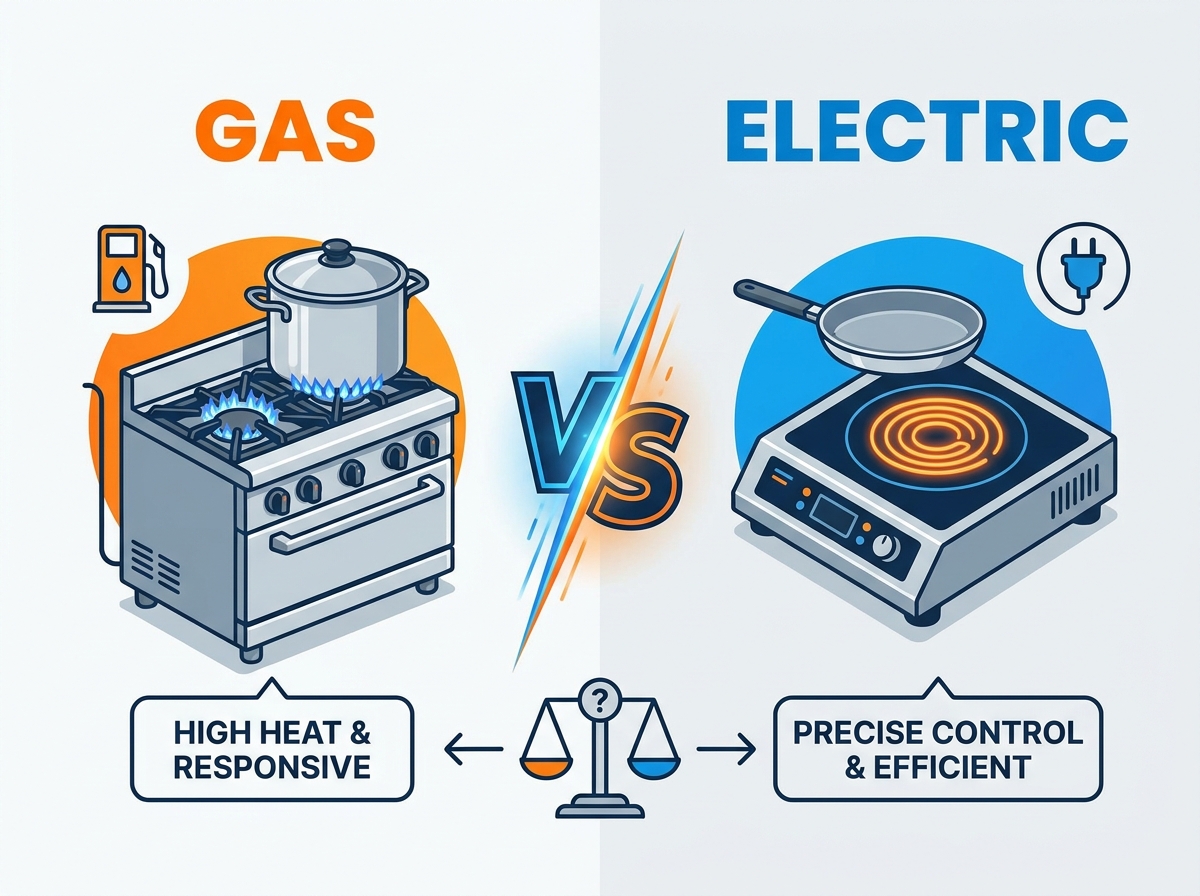
The choice of utility infrastructure dictates culinary execution, facility constraints, and safety protocols on the line. Operators often default to traditional preferences, assuming chefs always prefer gas. They make these choices without evaluating modern advancements in electric technology. They also overlook shifting municipal regulations and the true long-term financial impact involving ventilation, labor, and utility rates. Building out a commercial space requires looking past the initial purchase. You must account for daily operational realities. This guide provides an objective, evidence-based framework for evaluating gas vs electric commercial kitchen equipment. We compare performance metrics, installation realities, and operational trade-offs. You will learn how to spec the right infrastructure for your specific menu and facility constraints. We break down the exact utility requirements for different cooking methods, helping you avoid costly renovation mistakes.
Key Takeaways
Performance vs. Precision: Gas kitchen equipment delivers rapid heat-up times, high cooking power, and visual temperature control, while electric kitchen equipment excels in even heat distribution and precise temperature maintenance.
Infrastructure Costs: While natural gas is historically cheaper per BTU than electricity, gas equipment requires expensive Type I ventilation hoods, make-up air systems, and complex fire suppression installations.
Energy Efficiency & Environment: Electric equipment transfers a significantly higher percentage of consumed energy directly to the food, resulting in less ambient heat in the kitchen, lower HVAC cooling costs, and a smaller carbon footprint.
Regulatory Future-Proofing: With increasing municipal bans on new commercial gas hookups and a push toward decarbonization, electric and induction equipment offer a more compliant long-term investment in certain jurisdictions.
Table of Contents
Toggle
Baseline Success Criteria for Commercial Cooking Equipment
Menu and Volume Requirements
Your menu dictates your utility needs. Define the specific cooking techniques your kitchen requires daily. High-BTU wok cooking and intense charring demand rapid, aggressive heat. Low-and-slow baking or precise holding requires stability. You must also calculate your peak volume output. A high-volume steakhouse pushing hundreds of covers an hour has vastly different recovery time requirements than a neighborhood cafe. Match your equipment's energy output directly to your menu's most demanding dishes. If you run a high-volume burger concept, your griddle needs massive thermal mass and rapid recovery. If you operate a delicate patisserie, you need exact ambient temperature control inside the oven cavity. We always look at the menu first before looking at equipment spec sheets.
Facility Constraints
Never specify equipment without auditing your existing building infrastructure. Assess your current electrical panel amperage. Determine your existing gas line capacity. Evaluate the structural limits for hood ducting. Older buildings often lack the electrical capacity to support a fully electric hotline. You might find a standard panel when you actually need a heavy-duty 3-phase service to run multiple electric fryers and combi-ovens. Conversely, high-rise locations or historic spaces may prohibit running new black iron gas pipes. They might also restrict installing complex roof-level exhaust fans. Know your physical limitations before falling in love with a specific appliance. Pulling permits for new gas lines in dense urban centers takes months. Sometimes, the building simply dictates the utility.
Long-Term Financial Modeling
Move beyond the initial purchase price. The sticker price of an appliance represents a fraction of its lifetime cost. Calculate your local utility rates for both gas and electricity. Factor in maintenance frequency and the cost of replacement parts. Account for daily cleaning labor. Gas grates take longer to break down and scrub than flat electric surfaces. Finally, calculate ambient cooling costs. Hotter kitchens require more aggressive HVAC usage, driving up monthly overhead. You have to look at the utility bills for the entire building, not just the kitchen line. A massive gas range dumps heat into the room. Your air conditioning works overtime to compensate.
Sustainability Goals and Brand Positioning
Align your equipment choices with corporate environmental targets. Many modern brands prioritize environmental, social, and governance initiatives. Green building certifications heavily favor energy-efficient electric designs. Modern consumers also increasingly support businesses that demonstrate environmental responsibility. Decarbonizing your kitchen infrastructure can serve as a powerful brand differentiator. It also future-proofs your operation against tightening environmental regulations. We see more operators using their electric kitchens as a marketing tool. They promote their zero-emission cooking lines to eco-conscious diners.
Gas Kitchen Equipment: Performance, Costs, and Realities
Operational Advantages and Culinary Application
Gas burners deliver rapid heat response. When a chef turns the dial, the heat is instantaneous. This provides immediate recovery times during intense service rushes. The high cooking power of gas easily handles heavy stockpots and continuous pan work. Chefs rely on the tactile advantage of visual flame control. Seeing the flame allows for intuitive heat adjustments without looking at digital readouts. This historical familiarity keeps gas as the default choice for many veteran line cooks. They know exactly how a medium-high flame looks and behaves under a sauté pan.
Specific culinary applications heavily favor gas kitchen equipment. Charbroiling requires open flames to achieve signature crusts and smoky flavor profiles. Wok stations demand massive BTU output that wraps around the pan for authentic wok hei. High-volume sautéing relies on the immediate heat transfer that only an open flame provides when a pan is repeatedly lifted and shaken. You cannot easily replicate the aggressive flare-up of a gas charbroiler on an electric grate.
Long-Term Expense Factors
Natural gas historically costs less per BTU than commercial electricity in most North American markets. This raw utility cost advantage often makes gas appealing for high-volume operations running equipment all day. Mechanical gas components also boast impressive durability. Valves, pilot lights, and thermocouples are relatively simple. They cost less to replace than complex electric circuit boards. A well-maintained gas range can endure decades of heavy abuse with minimal expensive repairs. When a gas valve fails, a technician swaps it out quickly. You rarely have to wait for proprietary software updates or specialized microchips.
Implementation Risks and Facility Constraints
Installing gas equipment triggers strict infrastructure requirements. You must install expensive Type I ventilation hoods to capture grease and smoke. These hoods require dedicated make-up air units to balance kitchen air pressure. You also need complex fire suppression systems integrated into the hood. These installations add massive upfront build-out costs. Running black iron pipe requires specialized plumbers and rigorous pressure testing.
Gas introduces inherent safety risks. Open flames cause burns. Combustion produces carbon monoxide emissions, requiring vigilant ventilation maintenance. Potential gas leaks pose catastrophic fire risks. Furthermore, operators face a growing risk of municipal gas bans. Many cities now enforce strict emission regulations, prohibiting new commercial gas hookups. This regulatory shift directly impacts new restaurant build-outs and future facility renovations. If you sign a ten-year lease, you must ensure your gas infrastructure remains compliant for the duration.
Electric Kitchen Equipment: Performance, Costs, and Realities
Operational Advantages and Culinary Application
Electric elements provide superior heat consistency. They deliver even heat distribution across cooking surfaces. This makes electric kitchen equipment ideal for griddles, fryers, and convection ovens. Pancakes cook evenly without hot spots. Fryer oil maintains precise temperatures, extending oil life and improving food quality. Baking results become highly repeatable due to exact thermostat control. You eliminate the cold spots often found on older gas flat tops.
Commercial induction technology represents a high-performance subset of electric cooking. Induction uses magnetic fields to heat the pan directly. It offers faster boiling times than traditional gas burners. It also produces zero wasted ambient heat. The kitchen stays cool, and the energy goes directly into the food. Electric equipment also offers unmatched portability and modularity. You can move 120V or 240V equipment easily. You can reconfigure your hotline for different menus. Caterers, food trucks, and pop-ups utilize electric units without requiring a plumber or hard-piped gas lines.
Long-Term Expense Factors
Commercial electricity carries a higher baseline cost than natural gas. However, direct energy conversion offsets this rate difference. Electric elements convert nearly 100% of incoming energy to heat. Gas loses a massive percentage of its heat to the ambient air. You pay for gas heat that simply vents out of the hood.
Calculate the secondary savings of electric equipment. Reduced ambient heat means significantly lower HVAC cooling costs during summer months. Your air conditioning works less, saving money and reducing system wear. Electric equipment also tends to have an improved lifespan due to the lack of destructive open flames and intense ambient heat degrading nearby components. The working environment remains comfortable, which indirectly reduces staff turnover and hiring expenses.
Implementation Risks and Facility Constraints
The biggest hurdle for electric kitchens is electrical capacity. Upgrading a building's electrical panel requires significant capital. Moving from a standard service to a heavy-duty 3-phase power system involves heavy construction. Landlords may resist these upgrades. You must verify your panel capacity before committing to a fully electric hotline. Pulling new heavy-gauge copper wire through an old building presents logistical nightmares.
Traditional electric resistance coils also suffer from slower initial heat-up times. They lag behind gas when recovering temperature after dropping cold food into a pan. While induction solves this problem, standard electric ranges require chefs to adjust their timing and prep strategies to accommodate slower thermal responses. You have to anticipate the heat rather than reacting to it instantly.
Head-to-Head Evaluation: Gas vs Electric Commercial Kitchen Equipment
Heat Control and Production Volume
Establishing true production parity requires comparing BTU output equivalents to kW ratings. A standard commercial gas burner outputs around 30,000 BTUs. An equivalent commercial induction burner requires about 3.5 kW to 5 kW to match that boiling speed. During peak service, recovery times dictate kitchen flow. Gas flames recover instantly. Standard electric elements struggle with rapid recovery. Induction coils match or exceed gas recovery times, transferring massive energy directly to the cookware. We measure success by how fast a fryer returns to 350 degrees after dropping a basket of frozen fries.
Facility Infrastructure and Ventilation Requirements
Ventilation requirements drastically impact upfront build-out costs. Gas equipment always requires heavy-duty Type I hoods due to combustion byproducts and grease. Some electric equipment, particularly ovens and holding cabinets, only require Type II hoods for heat and moisture removal. Type II hoods cost significantly less to purchase, install, and operate. They do not require complex fire suppression drops.
Your utility choice heavily impacts historical building renovations. Non-traditional spaces like ghost kitchens, mall food courts, and airport terminals often prohibit open flames. Running new black iron ductwork through a high-rise is usually structurally impossible. Electric equipment bypasses these restrictions, allowing operators to open concepts in highly restricted, lucrative locations.
Safety, Cleanliness, and Working Environment
Daily cleaning labor directly impacts your bottom line. Breaking down gas ranges takes time. Staff must remove heavy cast-iron grates, soak them, scrub carbon buildup, and clean out clogged burner ports. Electric and induction surfaces wipe clean in seconds. A flat glass induction top requires only a damp cloth and mild cleaner. This saves hours of paid labor every week.
Feature
Gas Equipment
Electric/Induction Equipment
Cleaning Labor
High (removable grates, burner ports)
Low (flat surfaces, easy wipe-down)
Workplace Safety
Open flame burns, carbon monoxide risks
No open flames, cooler surfaces (induction)
Ambient Temperature
High (50-70% heat loss to air)
Low (efficient energy transfer)
Ventilation Needs
Strict Type I hoods, make-up air
Type I or Type II depending on appliance
Workplace injury risks differ wildly. Gas introduces open flame burns, flare-ups, and carbon monoxide exposure. Electric equipment relies on standard electrical safety protocols, eliminating combustion risks. Finally, consider staff retention. Gas creates a significantly hotter, more exhausting working environment. A cooler, electric-driven kitchen improves staff comfort, reduces fatigue, and helps retain valuable culinary talent in a competitive labor market. Line cooks prefer working in a 75-degree kitchen over a 95-degree kitchen.
How to Choose the Right Equipment for Your Concept
When to Specify Gas Equipment
Specify gas for high-volume traditional restaurants, bustling steakhouses, and authentic Asian cuisines. These concepts require intense, immediate heat and open flames for charring and wok cooking. Choose gas if your facility already possesses existing, up-to-code gas infrastructure and installed Type I hoods. Utilizing existing infrastructure saves massive capital. Gas also makes sense in locations where natural gas prices remain heavily subsidized or significantly cheaper than local commercial electricity rates. If the building already has a massive gas manifold, use it.
When to Specify Electric Equipment
Specify electric for bakeries, cafes, and concepts relying on precise temperature control. Convection baking, holding cabinets, and deep frying benefit immensely from stable electric thermostats. Choose electric for non-traditional locations like airports, high-rises, or historic buildings. In these spaces, running new gas lines or installing black iron ductwork is structurally impossible or cost-prohibitive. Finally, pivot to electric if you operate in progressive municipalities with strict carbon emission targets or active gas bans.
The Hybrid Approach: Optimizing the Hotline
You do not have to choose just one utility. The most efficient kitchens utilize a hybrid approach. Mix utilities to maximize efficiency and performance. Spec gas for your open-burner ranges and heavy-duty charbroilers where visual flame and high heat matter most. Utilize electric equipment for your deep fryers, combi-ovens, and holding cabinets. Electric fryers recover temperature beautifully and extend oil life, while electric combi-ovens offer unmatched baking precision.
Implementing a hybrid kitchen requires strategic staff training and change management. Overcome the traditional bias by actively training your culinary teams. Demonstrate the precision, safety, and comfort benefits of modern electric and induction systems. Show them how induction boils water faster than their favorite gas burner. When chefs experience a cooler kitchen and faster cleaning times, adoption resistance fades quickly.
Conclusion
Conduct a comprehensive utility audit of your space to determine exact electrical amperage and gas line capacities before signing a lease.
Consult with a commercial kitchen designer regarding local hood regulations and municipal emission codes to ensure long-term compliance.
Request lifetime operating cost projections from equipment dealers, factoring in utility rates, HVAC savings, and preventative maintenance schedules.
Test induction equipment in a live demo kitchen to evaluate its recovery time and performance against traditional gas burners.
FAQ
Q: Is electric kitchen equipment cheaper to run than gas?
A: Raw natural gas rates are often cheaper than electricity. However, electric equipment is highly efficient, converting nearly 100% of energy directly into heat. Gas loses up to 70% of its heat to the ambient air. When you factor in the massive HVAC cooling savings and reduced ventilation needs, electric equipment often costs less to operate long-term.
Q: Do I need a ventilation hood for electric commercial kitchen equipment?
A: It depends on the cooking process, not just the utility. If you use electric equipment to cook grease-producing foods like burgers on a griddle or frying chicken, you still need a Type I hood. For non-grease cooking, like baking bread in an electric oven, a simpler Type II hood is usually sufficient.
Q: Why do chefs traditionally prefer gas commercial ranges?
A: Chefs prefer gas due to tactile feedback and visual flame control. They can see the heat level and adjust it instantly without looking at a dial. Gas also provides immediate high cooking power and rapid recovery times, which is essential for pan-flipping and intense service rushes.
Q: Is induction considered electric kitchen equipment?
A: Yes, induction is a highly efficient subset of electric equipment. Instead of using radiant heat from a glowing coil, induction uses magnetic fields to generate heat directly inside the cookware. This results in faster boiling times, precise control, and zero wasted ambient heat.
Q: Are local governments banning commercial gas kitchen equipment?
A: Yes, many progressive municipalities are implementing decarbonization trends and updating green building codes. These new regulations often ban or heavily restrict new commercial gas hookups to reduce carbon emissions, forcing new restaurant build-outs to rely entirely on electric infrastructure.
Q: Which equipment lasts longer: gas or electric?
A: Gas equipment generally boasts mechanical simplicity. Valves and pilot lights are durable and cheap to repair, allowing gas units to last decades. Modern electric equipment relies on complex digital boards that can be expensive to replace, though electric units suffer less heat degradation over time.
Q: Which type of equipment is easier to clean?
A: Electric and induction equipment is significantly easier to clean. Flat glass or metal surfaces can be wiped down in seconds. Gas equipment requires breaking down heavy cast-iron grates, soaking components, and scrubbing clogged burner ports, which adds hours of daily labor.
Today,we are proud to offer over 5,000 types of food machinery, including kitchen equipment, bakery equipment, and hospitality products. We are particularly prominent in the field of refrigeration, such as flast freezers, coolers, ice makers, etc. We often provide quality engineered equipment for restaurants, bakeries, schools, hotels, companies and other projects, and have received rave reviews from our customers.
CONTACT US
+86-137-2686-2678 +86-137-6077-3620 ivy@cnglead.com.cn Buliding 101, No.44 Fuxing Road, Shawan Street, PanYu District, Guangzhou City, Guangdong Province, China