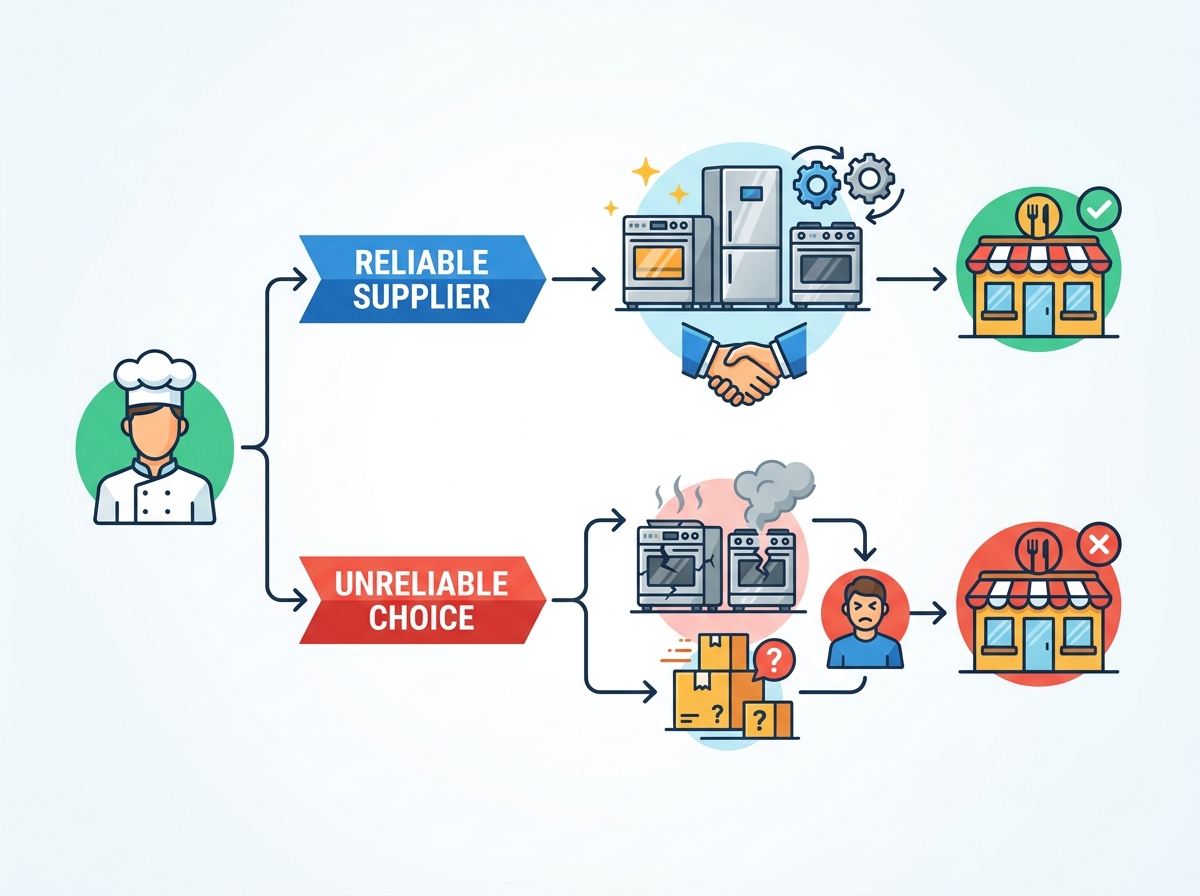
A restaurant's daily uptime depends entirely on the reliability of its cooking platforms and refrigeration units. When a primary range fails during a Friday dinner rush, the operational impact is immediate. Choosing a vendor is a critical risk-management decision. Food service operators face high stakes when allocating capital expenditure for new builds or kitchen upgrades. Choosing a vendor based solely on upfront sticker price often leads to catastrophic downtime, voided warranties, and delayed restaurant openings. Operators need a systematic evaluation framework to vet potential partners. You must look beyond the initial transaction. Evaluate a vendor based on their service infrastructure and operational alignment. The right partner provides preventative maintenance, rapid emergency response, and reliable parts sourcing. We will break down exactly how to evaluate vendors, mitigate supply chain risks, and secure equipment that supports your long-term operational success.
Key Takeaways
Service Over Price: The true value of a supplier is measured by their after-sales support, authorized technician network, and preventative maintenance capabilities.
Vendor Typology: Understanding the structural differences between direct kitchen equipment manufacturers, national distributors, and local dealers is essential for aligning with your specific procurement needs.
Warranty Verification: Never assume standard coverage; explicitly verify the differences between parts, labor, and compressor warranties, including who holds the liability for fulfillment.
Implementation Realities: Lead times, freight logistics, and installation liability must be contractually defined before issuing a purchase order.
Table of Contents
Toggle
Defining Your Operational Success Criteria
Menu Requirements vs. Equipment Specifications
Your menu dictates every equipment specification in your kitchen. Specific culinary outputs require exact durability levels and production capacities. A high-volume steakhouse needs heavy-duty broilers with high BTU output to handle constant, intense heat. A small cafe might only require a light-duty griddle for occasional breakfast sandwiches. You must match the equipment's duty cycle to your expected daily volume. Undersized equipment will fail prematurely under heavy use, leading to constant repair bills. Oversized equipment wastes valuable floor space and increases ambient kitchen heat, forcing your HVAC system to work harder. Detail your exact menu items, cooking methods, and peak volume expectations before reviewing any product catalogs.
Duty Cycle
Typical Usage
Best Application
Light-Duty
1-3 hours per day
Cafes, concession stands, small bakeries
Medium-Duty
4-8 hours per day
Diners, mid-sized independent restaurants
Heavy-Duty
8-24 hours per day
High-volume steakhouses, hospitals, large hotels
Budget Allocation and Equipment Prioritization
Capital expenditure in food service often causes initial sticker shock. Overcome this by categorizing your purchases strategically. Separate your list into mission-critical assets and secondary prep items. Mission-critical items directly impact your core menu and require premium investment. These include your primary ranges, fryers, and walk-in coolers. If these go down, your kitchen stops serving food. Secondary items like stainless steel prep tables, shelving, and basic hand sinks offer room for budget strategies. Allocate the bulk of your capital to the equipment that generates your revenue. Compromising on primary cooking platforms always leads to higher repair costs and lost revenue later.
Spatial and Utility Constraints
Never engage a vendor without a complete audit of your existing kitchen infrastructure. Physical space is only the first constraint. Many operators buy a double-door reach-in cooler only to realize it will not fit through their standard 36-inch back door. You must verify your utility capacities before placing an order.
Measure all entryways: Check the width and height of every door, hallway, and tight corner between the loading dock and the kitchen.
Verify electrical panel capacity: Audit your panels for correct phasing and voltage. A three-phase oven will not operate on a single-phase electrical drop.
Calculate total gas BTU requirements: Check your available gas line BTUs to ensure they can power new cooking blocks without starving other appliances.
Assess ventilation hood dimensions: Code usually requires a 6-inch overhang on each side of your cooking equipment. A 48-inch range requires a 60-inch hood.
Scalability and Volume Growth
Evaluate equipment for your opening day and your future peak service volumes. A successful restaurant will eventually outgrow its initial production capacity. Look for modular equipment that allows for easy expansion. Consider units that offer programmable controls to standardize recipes as you hire more staff. Think about future menu expansion. If you plan to add baked goods later, ensure your initial oven purchase accommodates those specific temperature controls. Buying with scalability in mind prevents the need for complete kitchen overhauls during your first three years of operation.
Types of Restaurant Equipment Suppliers: Which Fits Your Model?
Direct Kitchen Equipment Manufacturers
Purchasing directly from a kitchen equipment manufacturer makes sense for highly customized fabrication. If you need specialized ventilation systems, custom stainless steel fabrication, or proprietary cooking technology, direct purchasing is ideal. This route often yields lower costs on specific, high-volume items because you bypass the middleman. However, there are distinct trade-offs. Manufacturers specialize in their own product lines. They lack cross-brand integration capabilities. If you need a complete kitchen package featuring multiple brands, a direct manufacturer cannot fulfill that order. You will have to manage multiple vendor relationships and coordinate separate delivery schedules.
National Commercial Kitchen Equipment Suppliers
National distributors offer massive advantages in scale and logistics. They maintain broad inventory levels across multiple warehouses nationwide. This scale allows them to offer aggressive volume purchasing discounts and comprehensive online catalogs. You can outfit an entire kitchen from a single website. However, national scale introduces specific risks. The service can feel depersonalized. When a unit breaks down, a national commercial kitchen equipment supplier often relies on third-party local contractors for repairs. This extra layer of communication can delay emergency service. National vendors work best for operators who already have established relationships with local repair technicians.
Local Dealerships and Service-First Vendors
Local dealerships prioritize relationship-based procurement. They offer rapid on-site troubleshooting and personalized kitchen design consultations. Many local vendors provide loaner equipment programs if your primary unit requires extensive shop repairs. This localized support is invaluable during a weekend equipment failure. The main limitation is their smaller inventory footprint. They may not stock highly specialized items, requiring longer lead times for special orders. Additionally, local dealers might have slightly higher upfront costs compared to national mega-distributors. Operators must weigh this initial cost against the value of immediate, localized service.
Core Evaluation Dimensions for Vetting Suppliers
Industry Reputation and Peer Vetting
Researching a supplier's track record requires more than reading website testimonials. Look for affiliations with recognized industry associations. Seek out verified peer reviews from other local operators. Ask the supplier for relevant case studies or references from food service operations similar to yours. If you run a high-volume hospital cafeteria, a reference from a small coffee shop is not helpful. Call these references directly. Ask about the supplier's communication during delays and their responsiveness to warranty claims. A reliable vendor will gladly provide contact information for satisfied clients.
After-Sales Support and Preventative Maintenance
The relationship with your supplier truly begins after the equipment is installed. Audit their service level agreements carefully. Ask about their guaranteed response times for emergency dispatch. Do they offer weekend and holiday support for critical refrigeration failures? Review their preventative maintenance programs. Routine calibration and cleaning extend the lifespan of complex cooking platforms. A vendor that offers scheduled maintenance contracts demonstrates a commitment to your long-term operational success. Avoid suppliers who treat the relationship as a one-time transactional sale.
Warranty Structures and Fulfillment
Commercial warranties are complex and highly conditional. Never assume standard coverage applies universally. You must explicitly verify the differences between parts, labor, and compressor warranties. Often, a compressor has a five-year parts warranty, but the labor to install it is only covered for one year. The labor can easily cost more than the part itself. Clarify who holds the liability for fulfillment. Does the restaurant equipment supplier use an in-house authorized repair network? Or do they outsource warranty work to third-party regional dispatchers? In-house service teams generally resolve warranty claims much faster than outsourced networks.
Inventory Availability and Replacement Part Sourcing
Supply chain bottlenecks can paralyze a commercial kitchen. When a proprietary control board fails, you cannot wait weeks for an overseas shipment. Discuss the supplier's domestic parts inventory. Do they stock common wear-and-tear components locally? Ask about their fulfillment rate for replacement parts. A vendor with a robust local parts warehouse mitigates the risk of extended downtime. If they have to order every replacement part directly from the factory, your kitchen remains compromised while you wait for shipping.
Regulatory Compliance Expertise
A reliable supplier must possess deep knowledge of industry regulations. Equipment must meet strict health and safety standards. Verify that the vendor understands NSF certifications for sanitation and food safety. Discuss Energy Star ratings for utility efficiency. More importantly, the supplier must understand local municipal health and fire codes. Different cities have varying requirements for ventilation hoods, grease traps, and fire suppression systems. A knowledgeable vendor will prevent you from purchasing equipment that fails local health department inspections.
Long-Term Value and Financial Trade-Offs
Upfront Sticker Price vs. Long-Term Operational Costs
Evaluating equipment requires looking past the initial invoice. You must calculate the long-term operational costs over a five to ten-year horizon. Factor in daily energy consumption. High-efficiency fryers cost more upfront but save thousands in gas and cooking oil over their lifespan. Consider the expected lifespan of the unit and the cost of routine maintenance. A cheaper, light-duty range will require frequent repairs and early replacement in a high-volume setting. Investing in heavier-duty equipment reduces lifetime repair bills and prevents revenue loss from unexpected downtime.
New vs. Certified Refurbished Options
Budget constraints are a reality for many food service operators. Certified refurbished equipment serves as a highly viable budget strategy. It provides operational reliability without the premium cost of brand-new units. However, you must evaluate the supplier's refurbishment process.
Check the compressor age on refrigeration units.
Inspect all gaskets, seals, and hinges for wear.
Verify the warranty terms for both parts and labor.
Ask for the testing logs to ensure the unit holds temperature under load.
A reputable vendor will stand behind their rebuilt equipment with a solid parts and labor guarantee. Avoid buying used equipment as-is from unverified sources.
Financing, Leasing, and Capital Expenditure Strategies
Financial flexibility is a major differentiator among equipment vendors. Compare the financing programs offered by different suppliers. Lease-to-own programs allow you to preserve working capital for payroll and marketing. In-house financing often provides faster approval times than traditional bank loans. Additionally, discuss Section 179 tax deduction eligibility with your accountant and the vendor. This tax code allows operators to deduct the full purchase price of qualifying equipment in the current tax year. A vendor who understands these financial strategies acts as a true business partner.
The "Value-Add" Factor
Procurement should include more than just shipping boxes to your back door. Evaluate suppliers based on their comprehensive value-add services. Do they offer design-build capabilities? A vendor that provides CAD kitchen layouts can optimize your workflow and improve kitchen efficiency. Look for suppliers who offer workflow consultation. They can analyze your menu and suggest equipment placements that reduce step counts for your line cooks. These value-add services streamline the build-out process and result in a much more functional kitchen environment.
Navigating Implementation Risks and Mitigation
Supply Chain Delays and Lead Time Guarantees
Equipment manufacturing often faces severe lead time fluctuations. You must negotiate delivery timelines aggressively. Ask for realistic, worst-case scenario shipping dates. Seek contractual protections against delayed shipments. If a critical piece of equipment is delayed by three months, it can push back your entire restaurant opening. Ask the vendor if they provide temporary loaner equipment in the event of severe factory delays. Get all lead time estimates and contingency plans in writing before issuing the final purchase order.
Freight, Receiving, and Installation Realities
Shipping commercial equipment involves complex logistics. Clarify the exact delivery method before the truck arrives. You must also understand freight liability. Know the difference between FOB origin and FOB destination. If the terms are FOB origin, you own the equipment the moment it leaves the factory, meaning you are liable for filing freight damage claims.
Freight Term
Definition
Operator Responsibility
Curbside Delivery
Driver leaves the crate on the sidewalk or loading dock.
You must move the equipment inside and uncrate it.
Liftgate Service
Truck uses a hydraulic lift to lower the crate to the ground.
Required if you do not have a raised loading dock.
White-Glove Installation
Delivery team brings the unit inside, sets it in place, and removes debris.
Minimal effort required, but carries a premium fee.
Staff Training and Equipment Onboarding
Modern commercial kitchens utilize highly advanced technology. Programmable combi-ovens and automated frying systems require specific operational knowledge. Require on-site operational and safety training from the supplier. Your kitchen staff must know how to program recipes, execute daily cleaning cycles, and perform basic troubleshooting. Improper use voids warranties and damages expensive components. A reliable vendor will send a factory-trained representative to conduct comprehensive onboarding sessions with your entire culinary team before opening day.
Conclusion
The most reliable equipment supplier acts as a long-term operational partner. They prioritize your daily uptime and long-term value over quick, transactional sales. Your kitchen's success relies on their ability to deliver durable equipment, rapid service, and accessible replacement parts. Do not compromise on after-sales support to save a small percentage on the initial purchase.
Filter your potential vendors by their local service capabilities. Demand completely transparent warranty terms and require references for their post-sale support. A thorough vetting process eliminates vendors who cannot support your volume or meet your local regulatory codes.
Audit your current kitchen utilities and measure all physical entryways.
Request itemized quotes from three different vendors.
Verify the warranty fulfillment process and local technician availability.
Confirm all freight terms and installation liabilities in writing.
FAQ
Q: What is the difference between a kitchen equipment manufacturer and a distributor?
A: A manufacturer designs, fabricates, and builds the equipment in their own factories. A distributor purchases equipment in bulk from multiple different manufacturers and resells it to food service operators. Distributors offer a wider variety of brands and cross-platform integration, while manufacturers offer direct access to specific, proprietary technology.
Q: How do I verify a commercial kitchen equipment supplier's warranty policy?
A: Request the full warranty documentation in writing before purchasing. Read the specific terms for parts, labor, and compressor coverage. Verify if the warranty is handled by the supplier's in-house technicians or outsourced to a third party. Always ask what specific actions or installation errors will void the coverage.
Q: Should I buy, lease, or finance commercial restaurant equipment?
A: Buying outright avoids interest fees but depletes working capital. Financing spreads the cost over time, preserving cash flow for daily operations. Leasing often includes maintenance and allows for easier upgrades later. Choose the method that best aligns with your current cash reserves and long-term tax strategies.
Q: Is it safe to buy used or refurbished restaurant equipment from a supplier?
A: Yes, provided it is certified refurbished by a reputable dealer. The supplier must completely rebuild the unit, replace all wear-and-tear components, and test it under load. Always demand a written parts and labor warranty on refurbished equipment to protect against immediate mechanical failures.
Q: What happens if my restaurant equipment arrives damaged from the supplier?
A: Inspect all deliveries immediately before signing the bill of lading. If you spot damage, note it explicitly on the delivery receipt or refuse the shipment entirely. If the terms are FOB destination, the supplier handles the freight claim. Take extensive photos of the damaged packaging and equipment immediately.
Q: What does "FOB" mean when ordering from a commercial kitchen equipment supplier?
A: FOB stands for "Free On Board" or "Freight On Board." It determines liability during shipping. "FOB Origin" means the buyer assumes liability and ownership once the carrier picks up the item. "FOB Destination" means the supplier retains liability for damage or loss until the equipment is delivered to your location.
Today,we are proud to offer over 5,000 types of food machinery, including kitchen equipment, bakery equipment, and hospitality products. We are particularly prominent in the field of refrigeration, such as flast freezers, coolers, ice makers, etc. We often provide quality engineered equipment for restaurants, bakeries, schools, hotels, companies and other projects, and have received rave reviews from our customers.
CONTACT US
+86-137-2686-2678 +86-137-6077-3620 ivy@cnglead.com.cn Buliding 101, No.44 Fuxing Road, Shawan Street, PanYu District, Guangzhou City, Guangdong Province, China