Margin pressures in the foodservice distribution sector force a massive strategic shift. Relying entirely on established domestic brands limits profitability and leaves distributors vulnerable to sudden supply chain shifts. To regain control over margins, many operators and distributors turn to direct overseas sourcing and proprietary branding. However, importing commercial foodservice equipment carries high stakes. A single misstep in regulatory compliance, inconsistent factory quality, or intellectual property theft instantly wipes out anticipated savings. This guide provides a technical and operational framework for importers, distributors, and large-scale operators. We break down how to evaluate manufacturing partners, mitigate supply chain risks, and successfully bring proprietary equipment to market. You will learn how to navigate complex certification requirements, structure your product portfolio, and protect your designs from competitors without relying on generic middlemen.
Strategic Alignment: Choosing between OEM, ODM, and white-labeling dictates your upfront tooling costs, time-to-market, and intellectual property ownership.
Compliance is Non-Negotiable: Importing equipment without verified, market-specific certifications (e.g., NSF, UL, CE) renders products legally unsellable and exposes importers to severe liability.
Total Landed Cost: Unit price is only a fraction of the investment; true profitability requires calculating freight, tariffs, tooling, and warranty-support infrastructure.
Risk Mitigation: Successful importing relies on strict Quality Control (QC) protocols, robust NNN (Non-Disclosure, Non-Use, Non-Circumvention) agreements, and third-party pre-shipment inspections.
Table of Contents
Toggle
Defining Your Sourcing Strategy: OEM vs. Custom vs. Private Label
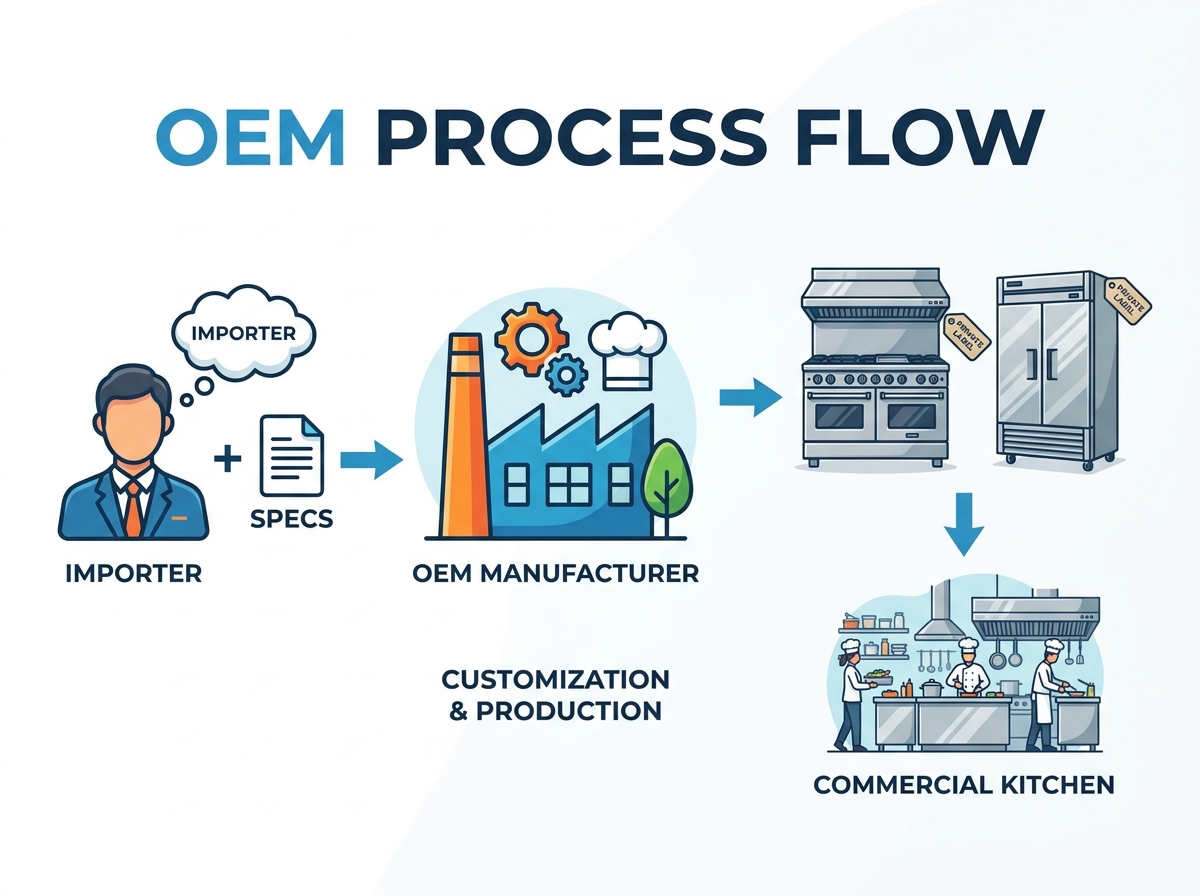
Selecting the right manufacturing model forms the foundation of your import strategy. Your choice directly impacts how quickly you launch, the capital required upfront, and the control you retain over the final product.
Private Label Kitchen Equipment (White-Labeling)
White-labeling involves purchasing off-the-shelf factory designs and applying your own branding. The manufacturer has already completed the research, development, and tooling. You simply select a unit from their catalog, specify your logo placement, and place an order.
This model offers the fastest time-to-market and the lowest Minimum Order Quantities (MOQs). Importers quickly fill gaps in their catalog without heavy capital investment. You have zero product differentiation. The factory owns the design, meaning direct competitors can purchase and sell the exact same units under a different brand name. Competing solely on volume becomes inevitable when selling private label kitchen equipment. You rely entirely on the factory's existing component choices, which means you cannot swap out a cheap thermostat for a higher-grade version without moving into a different sourcing model.
Under the OEM model, the factory manufactures equipment based entirely on your proprietary blueprints, specifications, and designs. You dictate the exact gauge of stainless steel, the specific brand of compressor, the wiring harness layout, and the precise dimensions of the unit.
This approach gives you maximum control over product features and complete intellectual property ownership. Nobody else can legally sell your exact design. The barriers to entry are much higher. Developing OEM commercial kitchen equipment requires significant upfront research and development. You pay for custom molds, stamping dies, and specialized tooling. Lead times stretch longer as you navigate multiple rounds of prototyping and testing before mass production begins. You must provide a comprehensive Bill of Materials (BOM) and detailed CAD files to ensure the factory executes your vision accurately.
Custom Kitchen Equipment (ODM / Co-Development)
Co-development, often referred to as Original Design Manufacturing (ODM), bridges the gap between white-labeling and pure OEM. You modify an existing factory design with custom features, dimensions, or upgraded components to suit specific market needs.
This strategy balances customization with cost-efficiency. You avoid the massive tooling expenses of a ground-up build while still creating a differentiated product. You might take a standard factory refrigeration unit and upgrade it with heavy-duty casters, a specialized digital controller, or modified dimensions to fit compact urban kitchens rather than large institutional spaces. Because the foundation belongs to the factory and the modifications belong to you, shared IP scenarios require careful legal navigation when importing custom kitchen equipment.
Structuring Your Product Portfolio: The "Good, Better, Best" Strategy
Smart importers leverage these different sourcing models to build a tiered product line. A tiered strategy allows you to capture different segments of the foodservice market without confusing your brand identity.
Good (Economy Tier): Utilize white-label sourcing. Focus on standard components, thinner gauge stainless steel (e.g., 430 series), and basic manual controls. This targets budget-conscious independent restaurants.
Better (Mid-Market Tier): Utilize ODM co-development. Upgrade to 304 stainless steel for critical touchpoints, integrate better insulation, and use branded thermostats. This targets regional chains requiring durability.
Best (Premium Tier): Utilize pure OEM manufacturing. Design units from scratch with heavy-duty components, advanced digital diagnostics, and proprietary energy-saving features. This targets high-volume institutional operators.
Sourcing Model
Time to Market
Upfront Tooling Investment
IP Ownership
Product Differentiation
Private Label (White-Label)
Fast (30-60 days)
None
Factory Owned
None
Custom (ODM / Co-Development)
Medium (90-120 days)
Moderate
Shared / Negotiated
Moderate
OEM (Original Equipment)
Slow (6+ months)
High
Importer Owned
High
Core Success Criteria for Evaluating Overseas Manufacturers
Finding a factory willing to take your order is easy. Finding a reliable manufacturing partner capable of consistently delivering safe, compliant, and high-quality equipment requires strict operational auditing.
Factory Specialization by Equipment Category
Avoid the generalist factory. Commercial foodservice equipment requires highly specialized manufacturing processes. A facility that produces excellent stainless steel worktables does not necessarily have the engineering capability to build commercial deep fryers.
Importers must seek specialized manufacturers for specific categories. A factory excelling in refrigeration units understands thermodynamics, refrigerant charging, and climate chamber testing. They lack the specialized tooling, gas flow testing equipment, and safety expertise required for gas cooking ranges or charbroilers. Partner with category experts rather than generalists to ensure product reliability. Look at their production lines; if you see ice machines being assembled next to gas ovens, walk away.
Production Capacity and Scalability
Never take a factory's claimed capacity at face value. You must assess their actual output capabilities. Request a virtual or in-person tour of their assembly lines during peak production hours. Look for bottlenecks in their workflow and evaluate their inventory of raw materials.
Evaluate their upstream supply chain. Ask where they source their critical components. Do they buy compressors directly from reputable brands like Embraco or Danfoss, or do they rely on unbranded local suppliers? A factory with a weak supply chain inevitably passes delays and quality inconsistencies onto you. Check their raw material staging areas to see if they hold enough stainless steel coil to handle large, unexpected orders.
Engineering and R&D Capabilities
Your manufacturing partner must translate North American or European design and spatial requirements into manufacturing reality. Audit their engineering team before signing any contracts. Ask what CAD software they use and request examples of previous design iterations.
Prototyping speed and accuracy indicate a competent R&D department. A strong engineering team quickly identifies flaws in your initial blueprints and suggests practical modifications to improve manufacturability. If a factory simply accepts your drawings without asking technical questions, they lack the engineering depth required for a successful partnership. They should push back on design choices that compromise structural integrity or inflate assembly time.
Quality Assurance (QA) and Testing Protocols
Robust in-house testing facilities separate elite manufacturers from average assembly plants. Outline the specific testing protocols required for your equipment. Refrigeration units require climate chambers to test performance under extreme ambient temperatures. Gas ranges require rigorous gas leak testing and burner efficiency evaluations.
Differentiate between final inspection and in-line quality control. Final inspection catches defects right before shipping, which leads to costly rework and delays. In-line quality control catches errors during the assembly process. Verify that the factory has dedicated QC staff stationed at critical assembly points.
Incoming Material Inspection: Verifying the gauge and grade of stainless steel before stamping.
Component Testing: Running dielectric withstand tests on all electrical harnesses before installation.
In-Line Assembly Checks: Inspecting TIG welds for porosity before the unit moves to polishing.
Functional Testing: Firing up gas burners to check flame characteristics and manifold pressure.
Final Packaging Inspection: Ensuring the unit is properly secured to the shipping pallet with adequate edge protection.
Navigating Regulatory Compliance and Certifications
Compliance is the highest hurdle in equipment importation. Foodservice operators face strict local health and fire codes. If your equipment lacks the proper certification marks, inspectors will red-tag the units, rendering them useless.
North American Standards (NSF, UL, ETL, CSA)
For the North American market, sanitation and safety certifications are an absolute necessity. NSF/ANSI standards dictate how equipment must be constructed to ensure it can be easily cleaned and will not harbor bacteria. This means specific radii on internal corners, approved food-zone materials, and easily removable components. Electrical and fire safety must be verified by Nationally Recognized Testing Laboratories (NRTLs) such as UL, ETL, or CSA.
Getting a custom product certified is a rigorous process. You submit detailed engineering drawings, component lists, and physical prototypes to the certifying body. The process involves destructive testing and mandatory quarterly factory audits to ensure ongoing compliance. Budget several months and significant capital for initial certification fees and ongoing file maintenance.
European and Global Standards (CE, RoHS, ISO)
Importing into the European market requires adherence to CE marking directives. This involves compiling a comprehensive technical file and issuing a Declaration of Conformity stating the equipment meets all relevant health, safety, and environmental protection standards. You must ensure compliance with RoHS, which restricts the use of specific hazardous materials in electrical components.
Importers often confuse factory-level certifications with product-level certifications. ISO 9001 indicates that the factory has a documented quality management system in place. It does not mean the specific fryer or refrigerator you are buying is certified for safety or sanitation. Always demand product-specific compliance documentation.
The "Fake Certification" Risk
Some overseas suppliers falsely claim their products are certified, pasting unauthorized UL or NSF logos onto their equipment. Importing falsely certified equipment carries severe legal and financial consequences. You face massive fines, forced product recalls, and catastrophic liability if a non-compliant unit causes a fire or foodborne illness outbreak.
Verify all certification claims independently. Do not rely on PDFs provided by the factory, as these are easily forged. Use the online directories provided by NSF, UL, and Intertek (ETL). Search for the factory's exact name and the specific model numbers you intend to purchase. If the product is not listed in the official database, it is not certified.
Certification Mark
Region
Primary Focus
Verification Method
NSF
North America
Sanitation and Food Safety
NSF Online Directory
UL / ETL
North America
Electrical and Fire Safety
UL Product iQ / Intertek Directory
CE
Europe
Health, Safety, Environmental
Declaration of Conformity & Technical File
The Cost-to-Value Equation: Total Landed Cost Analysis
Relying solely on the factory's quoted unit price is a dangerous miscalculation. True profitability requires a comprehensive analysis of every expense incurred from the factory floor to your warehouse dock.
Minimum Order Quantities (MOQs) and Tooling Costs
Custom molds, stamping dies, and specialized tooling significantly impact your initial capital requirements. Factories require these investments to configure their assembly lines for your specific designs. High MOQs are enforced to ensure the factory runs an efficient production batch.
Negotiation strategies help mitigate these upfront hurdles. Instead of paying for all tooling outright, propose amortizing the tooling costs over future purchase orders. You might agree to a slightly higher unit price for the first batch until the tooling is paid off. This reduces your initial cash outlay while guaranteeing the factory recoups their investment.
Freight, Tariffs, and Import Duties
Commercial kitchen equipment is heavy and bulky. Freight costs consume a massive portion of your budget. Calculate the volumetric weight of your shipments to accurately project shipping expenses. Optimizing packaging to fit more units into a standard 40-foot high-cube container directly improves your profit margins. Shaving just two inches off a crate's width can allow an extra row of equipment per container.
Import duties are dictated by Harmonized System (HS) codes. Misclassifying a piece of equipment results in unexpected tariff hikes or customs delays. A combination oven might be classified differently than a standard convection oven. Working with a licensed customs broker is essential to navigate HS code classifications and ensure you pay the correct duty rates.
Warranty Support: OEM vs. Aftermarket Parts Infrastructure
The financial burden of after-sales support falls entirely on the importer. You must stock replacement parts and manage warranty claims. The design of your equipment dictates your long-term parts strategy.
Importing proprietary replacement parts creates a captive, recurring revenue stream, as operators must buy specific components directly from you. This increases your inventory burden. Conversely, designing equipment to be compatible with universal aftermarket parts improves ease of maintenance for the end-user. This approach reduces long-term maintenance expenses for restaurant operators and minimizes the amount of spare parts you must warehouse domestically.
Implementation Risks and Mitigation Strategies
Supply chains are inherently fragile. Protecting your investments requires proactive risk management and legally binding agreements tailored to international trade.
Intellectual Property (IP) Protection
Standard Non-Disclosure Agreements (NDAs) drafted in your home country are generally useless when dealing with overseas manufacturers. If a factory copies your design, enforcing a domestic NDA across international borders is nearly impossible.
You need region-specific NNN (Non-Disclosure, Non-Use, Non-Circumvention) agreements drafted by lawyers licensed in the country of manufacture. An NNN prevents the factory from revealing your design, using your design for other clients, or bypassing you to sell directly to your customers. Register your trademarks and design patents in the manufacturing country before sharing any technical files.
Managing Supply Chain Disruptions and Lead Times
Manufacturing delays, port congestion, and material shortages are constant threats. Relying on just-in-time inventory eventually results in stockouts. Implement strategies for buffer inventory, carefully forecasting seasonal demand spikes to ensure you have adequate stock during peak purchasing periods.
Single-sourcing all your equipment from one factory creates a single point of failure. If that factory experiences a fire, labor strike, or sudden closure, your business halts. Once your volume justifies it, develop a secondary manufacturing partner. Splitting your orders ensures you have a backup supply line ready to activate if your primary factory falters.
Third-Party Inspections and Pre-Shipment Audits
Never release the final balance payment to a factory until the goods have been independently verified. Hiring independent inspection agencies provides a critical layer of quality control. The return on investment for these inspections is massive compared to the cost of receiving a container full of defective equipment.
Provide the inspection agency with a strict Acceptable Quality Limit (AQL) checklist. The inspector pulls a random sample of units from the finished batch, tests them against your criteria, and provides a detailed report. If the batch fails the AQL inspection, the factory must rework the units at their own expense before shipping.
Visual Inspection: Checking for scratches, dents, and proper application of branding decals.
Dimensional Inspection: Measuring the unit to ensure it matches the approved CAD drawings.
Functional Testing: Powering on the unit to verify thermostats, compressors, and heating elements operate correctly.
Packaging Inspection: Verifying the strength of the export crates and the presence of required shipping marks.
Successful importation requires shifting your focus from chasing the lowest possible unit price to building a reliable, compliant manufacturing partnership. Cutting corners on engineering, testing, or legal protection inevitably results in catastrophic financial losses down the line. Use a rapid disqualification framework to filter out bad factories early in the process. Immediately reject any manufacturer that lacks verifiable product certifications, refuses to sign a localized NNN agreement, outsources their engineering, or lacks specific category specialization.
To move forward, take the following actions:
Finalize your Tech Pack, including all CAD drawings, material specifications, and required compliance standards.
Draft a legally binding, region-specific NNN agreement before sharing any proprietary designs.
Begin the Request for Quotation (RFQ) process with a vetted shortlist of three to five specialized manufacturers.
Hire an independent inspection agency to establish your AQL parameters before placing your first trial order.
FAQ
Q: What is the typical MOQ for OEM commercial kitchen equipment?
A: Minimum Order Quantities vary drastically based on product size and manufacturing complexity. Large items like multi-door refrigeration units or heavy-duty ranges typically have MOQs of 20 to 50 units. Smaller items like countertop fryers, blenders, or induction burners usually require MOQs of 500 units or more to justify production runs.
Q: Can a factory use their existing NSF certification for my private label kitchen equipment?
A: Yes, but it requires a formal process. You cannot simply apply your sticker to their certified unit. You must establish a multiple listing or private label agreement with the certifying body. This links your specific brand and model number to the factory's existing certification file.
Q: How do I protect my custom kitchen equipment designs from being sold to competitors?
A: You must execute a localized NNN (Non-Disclosure, Non-Use, Non-Circumvention) agreement drafted under the jurisdiction of the manufacturing country. Register your patents and trademarks locally. For extreme protection, split the manufacturing of critical components across different factories so no single supplier possesses the complete design.
Q: What is the difference between OEM and ODM in foodservice equipment?
A: OEM (Original Equipment Manufacturing) means the factory builds a product entirely from your proprietary, ground-up designs and blueprints. ODM (Original Design Manufacturing) means the factory already has a base design, and you pay them to modify dimensions, upgrade components, or alter aesthetics to create a co-developed product.
Q: Who is responsible for warranty claims on imported commercial kitchen equipment?
A: The importer of record bears all legal and financial responsibility for warranties in the destination country. The overseas factory will not handle end-user claims, dispatch technicians, or cover local labor costs. Importers must build the cost of replacement parts and service networks into their financial models.
Q: Should I design my equipment to use OEM parts or aftermarket parts?
A: Using proprietary OEM parts creates a recurring revenue stream, as operators must buy replacements directly from you. However, utilizing universal aftermarket parts makes the equipment much easier and faster for local technicians to repair. This heavily appeals to high-volume restaurant operators prioritizing uptime over brand loyalty.
Today,we are proud to offer over 5,000 types of food machinery, including kitchen equipment, bakery equipment, and hospitality products. We are particularly prominent in the field of refrigeration, such as flast freezers, coolers, ice makers, etc. We often provide quality engineered equipment for restaurants, bakeries, schools, hotels, companies and other projects, and have received rave reviews from our customers.
CONTACT US
+86-137-2686-2678 +86-137-6077-3620 ivy@cnglead.com.cn Buliding 101, No.44 Fuxing Road, Shawan Street, PanYu District, Guangzhou City, Guangdong Province, China