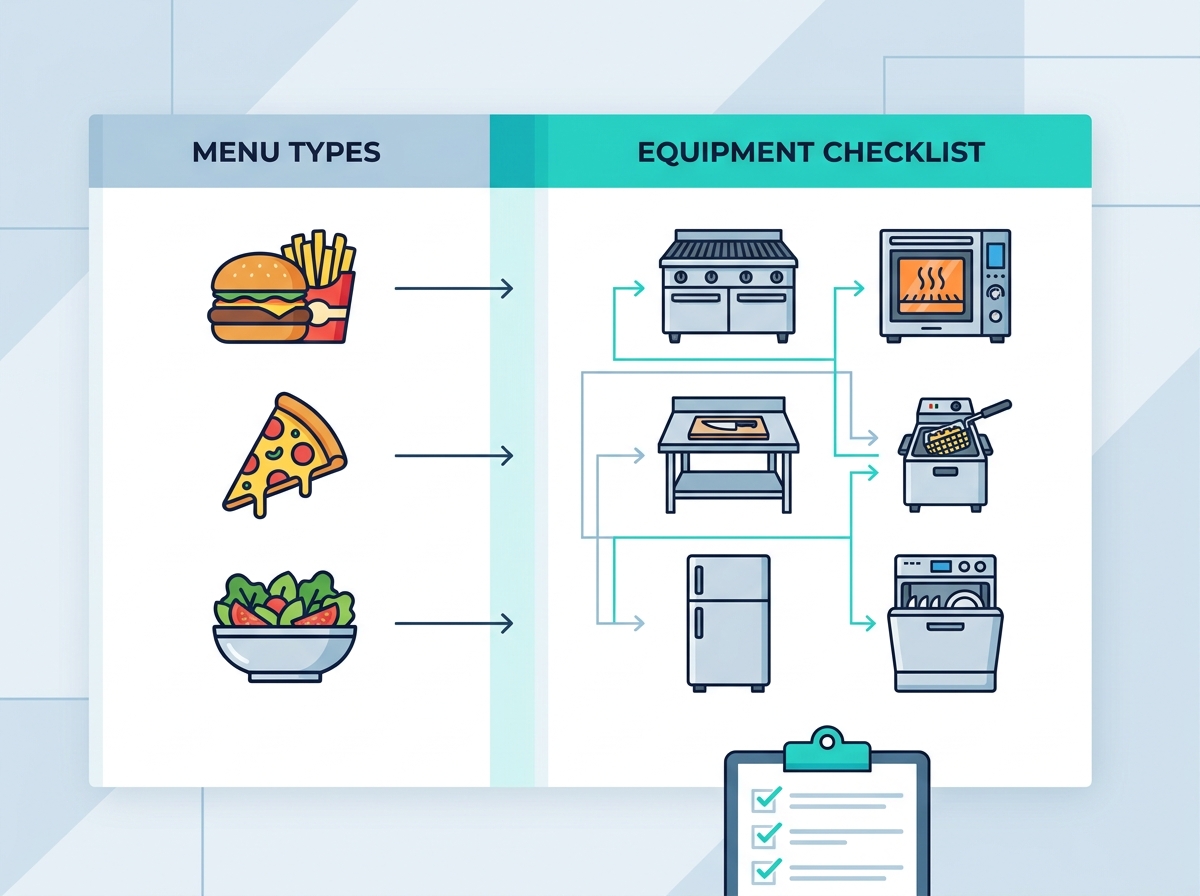
Commercial kitchen equipment represents the largest upfront capital expenditure for a new restaurant. Purchasing errors directly degrade operational margins, disrupt kitchen flow, and cripple staff efficiency. Relying on generic equipment lists is a dangerous trap. Buying unnecessary, oversized, or mismatched gear leads to wasted capital, cramped layouts, and utility overloads. Under-equipping causes severe service bottlenecks and inconsistent food quality during peak hours.
The solution lies in a menu-first approach to equipment sourcing. Every machine must justify its footprint. This guide provides a strategic, supplier-ready restaurant kitchen equipment checklist tailored to specific culinary concepts. You will learn how to evaluate long-term value, standardize specifications for multi-unit growth, and ensure complete regulatory compliance before signing a single purchase order.
Menu Dictates Machinery: Every piece of equipment must map directly to a menu item's prep, cooking, or holding requirements to justify its footprint and cost.
Utility and Space Constraints: Physical dimensions, hood space, and available power/gas lines are hard limits that must be audited before finalizing any restaurant equipment list.
Prioritization: Upfront pricing is only one factor; decision-makers must evaluate energy efficiency, warranty terms, maintenance availability, and prioritize day-one essentials over phase-two upgrades.
Standardization Scales Operations: For multi-unit concepts, standardizing equipment specifications cuts procurement costs and drastically simplifies staff training.
Compliance is Non-Negotiable: All selected equipment must meet local health codes, fire safety regulations, and carry appropriate commercial certifications (e.g., NSF, UL).
Table of Contents
Toggle
Why Your Menu Determines Your Kitchen Equipment Needs
Menu planning should guide equipment selection. Evaluate peak demand, food preparation steps, and cooking methods to determine the right equipment capacity. Choosing oversized equipment wastes space, energy, and budget, while undersized equipment creates service delays during busy periods. A well-designed kitchen layout should also follow the natural workflow from receiving and storage to preparation, cooking, serving, and cleaning, reducing unnecessary movement and improving efficiency.
Essential Equipment Every Commercial Kitchen Needs
Certain foundational items remain mandatory across almost every commercial kitchen. These categories form the backbone of safe, efficient food service operations.
Receiving Area and Food Handling Equipment
The receiving area manages the flow of incoming ingredients and supplies. Proper handling equipment, such as receiving scales, carts, and platform trucks, helps staff move goods efficiently while reducing labor and delays. Drainage solutions near loading areas also improve cleaning and hygiene. Without proper receiving equipment, inventory may be delayed, exposed to unsafe temperatures, or affected by contamination risks.
Commercial Refrigeration and Storage Solutions
Commercial refrigeration preserves inventory and ensures food safety. Walk-in coolers handle bulk storage. Reach-in refrigerators keep prepped ingredients accessible. Low-boy prep tables sit directly on the cooking line. They hold garnishes and proteins at safe temperatures. Compressor placement matters heavily. Top-mounted compressors avoid pulling in floor dust but require higher ceilings. Bottom-mounted compressors are easier to clean and perform well in hot environments, provided staff maintain the filters. Always verify ambient temperature ratings to ensure units can survive a sweltering commercial kitchen.
Dry Storage Equipment and Kitchen Organization
Effective dry storage prevents spoilage and maximizes vertical space. Epoxy-coated wire shelving resists rust in humid environments like walk-in coolers and dish pits. Heavy-duty dunnage racks hold massive bags of flour, sugar, and rice. Commercial ingredient bins with sliding lids keep pests out while allowing rapid access during prep. Health codes universally mandate keeping all stored items at least six inches off the floor to facilitate cleaning and pest control.
Food Preparation Stations and Tools
Preparation zones require durable, easy-to-clean surfaces. Heavy-gauge 304 stainless steel worktables resist corrosion and withstand constant knife work. Commercial food processors and meat slicers require high-horsepower motors to survive continuous daily use without overheating. Essential hand tools, cutting boards, and portion scales must integrate directly into these prep stations to maintain portion control and recipe consistency.
Dishwashing and Kitchen Sanitation Equipment
Dishwashing capacity must match your seat count and table turnover rate. Undercounter dishwashers suit small cafes and bars. Door-type machines handle medium-volume restaurants efficiently. High-volume dining halls require massive conveyor systems. High-temperature machines use booster heaters to sanitize with 180-degree water. Low-temperature machines rely on chemical sanitizers. Manual washing mandates a three-compartment sink for washing, rinsing, and sanitizing. Properly sized grease traps remain essential to prevent catastrophic plumbing failures.
Kitchen Ventilation and Fire Safety Systems
Ventilation systems represent a massive infrastructure investment. Type I commercial hoods extract grease and smoke from fryers, griddles, and ranges. Type II hoods remove heat and condensation from dishwashers and baking ovens. Makeup air units replace the exhausted air to maintain neutral building pressure. Without makeup air, doors become heavy to open, and HVAC systems fail. Ansul fire suppression systems integrated into the hood are non-negotiable for any grease-producing cooking equipment.
Restaurant Equipment Guide by Cuisine Type
Generic lists fail because different cuisines demand specialized machinery. Selecting kitchen equipment by menu ensures you only purchase gear that drives your specific operational goals.
Pizzeria & Italian Concepts
Pizza operations rely entirely on high-heat applications and dough management. The choice of oven dictates the entire kitchen rhythm. High-hydration doughs require specialized spiral mixers that fold the dough gently, developing gluten without generating excess friction heat. Standard planetary mixers will tear these delicate doughs.
Deck ovens produce authentic, artisan crusts but require highly skilled operators to rotate pies manually.
Conveyor ovens guarantee consistency and speed for high-volume delivery operations, requiring minimal training.
Spiral mixers handle low-hydration, heavy pizza dough without overheating the yeast, outperforming standard planetary mixers.
Dough rounders and dividers automate prep, saving massive amounts of labor.
Pizza prep tables feature raised rail cooling to keep cheese and perishable toppings strictly within safe temperature zones.
Burger & Quick Service Restaurant (QSR)
Speed, consistency, and rapid recovery times define QSR operations. The equipment must withstand relentless, high-volume abuse.
Heavy-duty griddles require thick steel plates (often one inch thick) for maximum heat retention when loaded with cold burger patties.
Charbroilers provide authentic grill marks and smoke flavor but demand extensive hood ventilation.
Multi-vat deep fryers need built-in oil filtration systems to extend oil life and maintain food quality.
Heated holding cabinets keep batch-cooked items ready for immediate assembly.
Rapid-toast bun systems and refrigerated condiment stations keep the assembly line moving without bottlenecks.
Fine Dining & Multi-Course
Precision, versatility, and compartmentalized workflows drive fine dining kitchens. The brigade system requires localized equipment for each chef. Blast chillers are essential for fine dining prep. They rapidly drop the temperature of cooked foods through the danger zone, preserving cellular structure and locking in moisture.
Combi-ovens offer unmatched precision, blending steam and convection to roast, poach, or bake with exact humidity control.
Sous-vide immersion circulators ensure exact protein temperatures, reducing waste on expensive cuts of meat.
Induction ranges provide instant heat control and keep the ambient kitchen temperature significantly cooler than gas ranges.
Salamanders finish, glaze, and melt cheese on plated dishes right before they hit the pass.
Blast chillers rapidly cool prepped items, allowing chefs to prepare complex sauces days in advance without sacrificing quality.
Bakery & Café
Bakeries require equipment optimized for volume baking, precise measurements, and front-of-house integration.
Convection ovens circulate hot air to bake multiple racks of pastries evenly without hot spots.
Planetary mixers offer versatile attachment options for batters, whips, and light doughs.
Dough sheeters ensure uniform pastry thickness for croissants and puff pastry, a task that is incredibly labor-intensive by hand.
Commercial espresso machines require dedicated water filtration systems to prevent scale buildup and ensure coffee quality.
Refrigerated display cases drive impulse sales at the register, while rapid-cook ovens warm pastries instantly for customers.
Ghost Kitchens & Delivery-Optimized
Ghost kitchens prioritize multi-brand flexibility and strict footprint optimization. Delivery logistics dictate the layout.
Ventless cooking equipment bypasses expensive traditional hood installations, allowing operations in unconventional real estate.
Stackable units maximize vertical space in cramped, high-rent urban locations.
Extensive hot and cold holding staging areas keep delivery orders at safe temperatures while drivers navigate traffic.
Robust kitchen display systems (KDS) route orders from multiple delivery apps to the correct prep stations seamlessly.
How to Evaluate Commercial Kitchen Equipment
Selecting the right brand and model involves navigating complex financial and operational trade-offs. Upfront pricing rarely reflects the true cost of operating heavy machinery over a ten-year lifespan.
Budgeting and Prioritization Guide
Allocate capital strategically across different kitchen zones. Protect your initial cash flow by distinguishing between day-one essentials and phase-two upgrades. A standard convection oven might handle your opening menu perfectly well. A high-end combi-oven, while versatile, can be deferred to a phase-two upgrade once revenue stabilizes. Prioritize spending on the primary cooking apparatus and reliable refrigeration. Failures in these categories will immediately shut down your restaurant.
Footprint vs. Production Capacity
Calculate the yield per square inch of floor space. In tight urban kitchens, every inch matters. Multi-functional equipment consolidates footprints effectively. A single combi-oven can replace a steamer, a standard convection oven, and a proofing cabinet. Stackable fryers and ovens utilize vertical space, doubling production capacity without expanding the hood footprint. Always measure doorways and hallways to ensure the equipment can physically enter the building.
Energy Efficiency and Utility Requirements
Compare the operational realities of different power sources before finalizing your equipment strategy.
Power Source
Operational Efficiency
Installation Requirements
Kitchen Impact
Gas
Low efficiency (high heat loss)
Requires dedicated gas lines, Type I hood, makeup air
Heats up the kitchen significantly; provides visual flame feedback.
Electric
Medium efficiency
Requires specific voltage/phase panels (often 3-phase)
More precise baking temperatures; slower recovery times than gas.
Induction
Maximum efficiency (minimal heat loss)
Requires compatible magnetic cookware, dedicated circuits
Match equipment specifications to your building's existing electrical panels and gas line capacities. Upgrading a building to three-phase power or increasing the gas line diameter requires extensive permits and construction delays.
Maintenance and Warranty Management
Equipment breakdowns are inevitable in a high-volume kitchen. How you manage those breakdowns determines your operational resilience. When evaluating different brands, scrutinize the warranty terms just as closely as the physical specifications. A one-year parts and labor warranty is standard, but premium manufacturers often extend compressor warranties to five years. Verify that authorized service agents operate in your local area. Buying a highly specialized imported oven is useless if the nearest certified technician is three states away. Establish a preventative maintenance schedule immediately upon installation. Routine tasks like descaling combi-ovens, cleaning condenser coils on refrigerators, and calibrating oven thermostats extend the lifespan of your machinery and prevent catastrophic failures during peak service hours.
Standardization for Multi-Unit Scalability
Scaling a restaurant concept demands strict equipment standardization. Standardizing specifications across all locations cuts costs through bulk purchasing agreements. It drastically simplifies staff training because employees operate the exact same machines regardless of which location they work in. Preventative maintenance protocols become uniform, allowing you to stock standard replacement parts. Sourcing your Restaurant Kitchen Equipment from a single trusted supplier streamlines this entire scaling process.
New vs. Used Equipment: A Risk Assessment
Buying used gear saves capital but introduces operational risk. Buy new for critical cooking components, refrigeration, and items requiring strict manufacturer warranties. A failed compressor on a used walk-in cooler will cost more in spoiled inventory than the initial savings. Buy used for items with no moving parts, such as stainless steel prep tables, three-compartment sinks, and durable wire shelving. Always evaluate the energy efficiency of older used models against the upfront savings.
Common Equipment Installation Challenges
Procuring the equipment is only half the battle. Logistical hurdles, regulatory inspections, and installation errors can delay your opening by months.
Health Codes and Equipment Certifications
Health inspectors enforce strict sanitation standards. NSF (National Sanitation Foundation) and UL (Underwriters Laboratories) ratings are mandatory for commercial operations. Non-compliant equipment lacks smooth, cleanable surfaces and proper temperature holding capabilities. Attempting to use residential equipment in a commercial setting will result in immediate failure during health inspections, halting your opening indefinitely.
Ventilation, Hood, and Fire Safety Requirements
Strict fire codes govern the ratio of cooking equipment to hood overhang. Typically, the hood must extend at least six inches beyond the edge of the cooking equipment. Upgrading ventilation to accommodate a new charbroiler often exceeds the cost of the charbroiler itself. Verify your ductwork sizing and exhaust fan capacities before adding heavy-duty, grease-producing ranges to your line.
Delivery, Installation, and Equipment Setup
Realistic procurement timelines prevent delayed openings. Custom fabrication and specialized ovens often carry lead times stretching several months. Coordinate delivery, uncrating, and professional installation meticulously. Execute a pre-opening start-up checklist to test and calibrate all equipment before opening day. Skipping professional start-up procedures often voids manufacturer warranties and leads to immediate service failures during your grand opening rush.
To ensure a smooth launch, follow a strict start-up sequence:
Verify all utility connections match the manufacturer specifications exactly.
Perform a dry run of all mechanical components, checking for unusual vibrations or noises.
Calibrate thermostats on all ovens, fryers, and refrigeration units using independent commercial thermometers.
Run a full sanitation cycle on the warewashing system to confirm chemical dispensing rates and water temperatures.
Schedule a final walk-through with your local fire marshal to test the hood suppression system.
Conclusion
A successful equipment strategy is not a generic shopping list. It is a strategic blueprint derived directly from your menu, physical layout, and operational goals. Purchasing blindly leads to cramped kitchens, blown budgets, and frustrated staff. Audit your menu to define exact production requirements. Measure your physical space to calculate footprint yields. Verify your utility capacities to avoid expensive electrical upgrades. Prioritize your budget toward day-one essentials and calculate lifecycle costs before requesting quotes.
Take these immediate next steps to finalize your build-out:
Finalize your exact menu specifications and peak volume projections.
Measure your physical kitchen footprint and map out the utility connection points.
Consult with a commercial kitchen designer to draft a linear, forward-moving workflow.
Submit your tailored equipment checklist to a reputable dealer for comprehensive quotes.
FAQ
Q: How do I budget for equipping a commercial kitchen?
A: Budgeting depends entirely on your concept size, menu complexity, and the mix of new versus used items. Quick-service setups require different capital allocations than fine dining. Focus on prioritizing day-one essentials. Allocate funds toward primary cooking apparatuses and reliable refrigeration first, leaving secondary prep tools for phase-two upgrades.
Q: What is the most important piece of kitchen gear?
A: The most critical item depends entirely on your menu. Generally, the primary cooking apparatus dictates kitchen success. A pizzeria relies on its deck oven, while a burger concept depends on a heavy-duty griddle. Reliable refrigeration is universally critical across all concepts to maintain food safety and minimize spoilage.
Q: Do I need a commercial hood for all cooking equipment?
A: Not necessarily. Grease-producing equipment like fryers and charbroilers require a Type I hood with fire suppression. Heat and moisture-producing equipment like dishwashers and certain ovens require a Type II hood. Ventless cooking equipment exists for specific applications, bypassing traditional hood requirements entirely. Always verify local fire and health codes.
Q: How do I choose gear for a small restaurant layout?
A: Prioritize vertical space and multi-functional machinery. Stackable ovens and combi-ovens consolidate multiple cooking processes into a single footprint. Utilize undercounter refrigeration and low-boy prep tables to maximize workable surface area. Measure every inch of floor space and select narrow-depth models where applicable.
Q: Should I lease or buy my culinary machinery?
A: Leasing preserves initial cash flow for startups and often includes maintenance plans, making it attractive for new ventures. Purchasing outright provides long-term cost savings, builds asset equity, and eliminates monthly equipment payments. Evaluate your available capital and long-term operational strategy before deciding.
Q: What is the difference between NSF and non-NSF equipment?
A: NSF certification is the industry standard for sanitation and food safety. It guarantees the equipment is constructed from materials that are easy to clean, non-toxic, and resistant to bacterial growth. Health inspectors typically require NSF-rated equipment for all commercial food service operations. Non-NSF items are generally for residential use.
Today,we are proud to offer over 5,000 types of food machinery, including kitchen equipment, bakery equipment, and hospitality products. We are particularly prominent in the field of refrigeration, such as flast freezers, coolers, ice makers, etc. We often provide quality engineered equipment for restaurants, bakeries, schools, hotels, companies and other projects, and have received rave reviews from our customers.
CONTACT US
+86-137-2686-2678 +86-137-6077-3620 ivy@cnglead.com.cn Buliding 101, No.44 Fuxing Road, Shawan Street, PanYu District, Guangzhou City, Guangdong Province, China