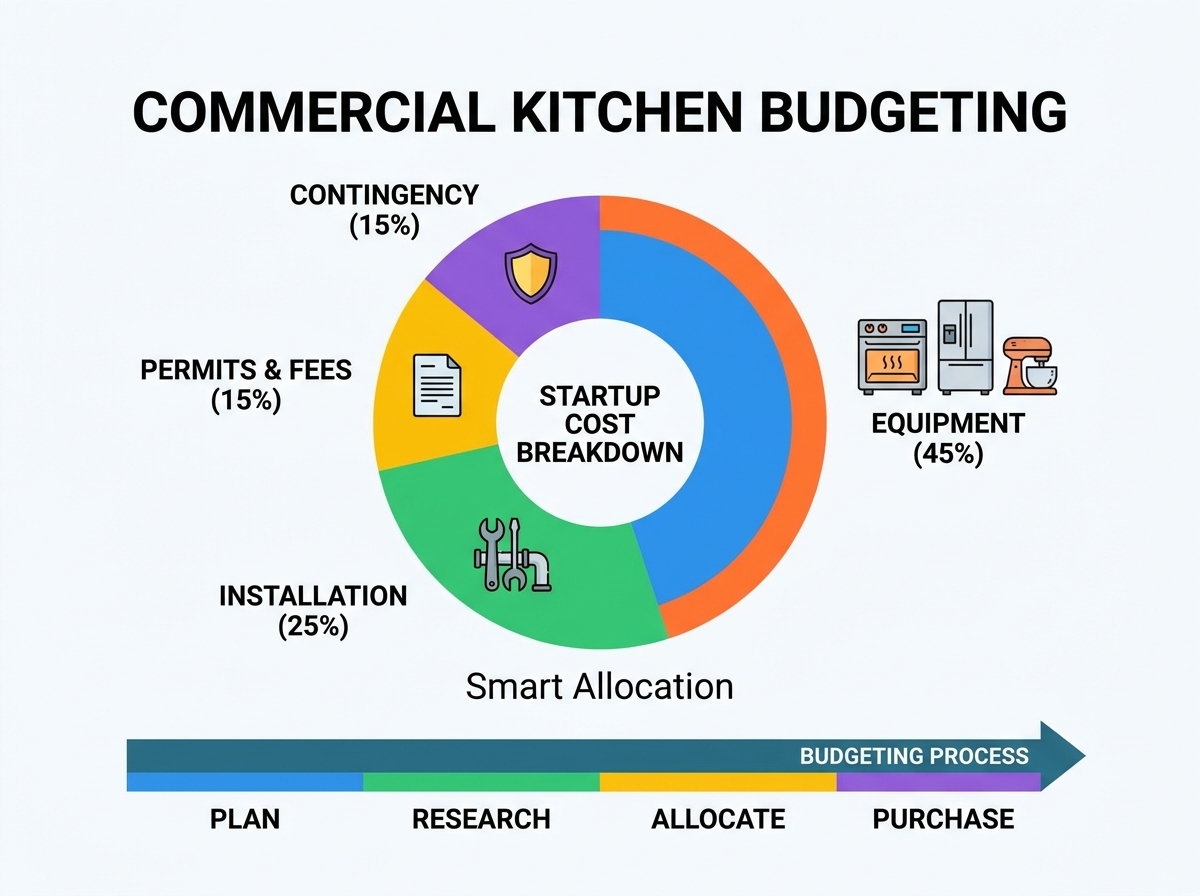
Restaurant failure rates often tie directly back to undercapitalization and inaccurate initial budgeting during the build-out phase. Operators frequently focus solely on the sticker prices of individual units, building financial models that look functional on paper but fall apart during execution. They ignore hidden lifecycle expenses like freight, uncrating, professional installation, facility modifications, and staff training. When these expenses hit, project reserves drain rapidly, leaving the operation starved for working capital before the doors even open.
Building a realistic financial model requires looking past the catalog price. You need a systematic framework for calculating your commercial kitchen startup cost. This involves balancing capital expenditure with daily operational requirements and evaluating procurement strategies that maximize long-term reliability. By anticipating the full scope of the build-out, you protect your operating capital and ensure the kitchen functions efficiently from day one.
Baseline Ranges: A full commercial kitchen fit-out typically ranges from $40,000 to $200,000+, heavily dependent on menu complexity, scale, and concept type.
Standard Allocation: A balanced budget generally allocates 40% to cooking equipment, 25% to refrigeration, and 35% to prep, storage, and warewashing.
Hidden Cost Factors: Freight, professional installation, and staff training routinely add 15–20% to base restaurant equipment prices.
Procurement Strategy: Blending new equipment (for high-liability, critical-path items) with refurbished units (for durable, non-mechanical items) optimizes initial capital without sacrificing operational reliability.
Table of Contents
Toggle
Framing the Budget: Commercial Kitchen Startup Cost Baselines
Average Cost Ranges by Concept and Scale
Different operational models demand entirely different equipment footprints. A quick-service restaurant prioritizes speed and high-volume output for a limited menu. The equipment package here leans heavily on specialized, rapid-recovery items like high-efficiency fryers and rapid-cook ovens. You will spend heavily on holding cabinets and heated display cases to keep the line moving during peak rushes.
Fine dining establishments require precision and versatility. Their kitchens feature complex stations, sous-vide circulators, multi-zone combi ovens, and extensive plating areas. The footprint is larger, and the machinery is highly specialized. You need dedicated prep areas for different proteins and extensive refrigeration to separate raw ingredients to prevent cross-contamination.
Ghost kitchens operate on a different logic. They eliminate front-of-house expenses entirely, channeling all available capital into high-density cooking lines. These facilities often stack equipment vertically to maximize output per square foot. You might see double-stacked convection ovens and undercounter refrigeration used extensively to save space under the hood.
Institutional cafeterias focus on bulk production and holding. Their budgets skew toward massive steam kettles, tilt skillets, and high-capacity holding cabinets. Menu complexity directly dictates the required machinery. A simple menu keeps the equipment list short and manageable. A sprawling menu forces you to buy single-purpose machines that eat up floor space and drain the budget.
The Standard Equipment Budget Breakdown
Industry standards provide a reliable baseline for allocating capital across different categories. While exact figures vary, the proportional breakdown remains consistent across many concepts. A balanced financial model typically allocates funds according to these ratios.
Cooking Equipment (~40%): This is the engine of the operation. It includes ranges, ovens, fryers, and griddles. You allocate the largest chunk of your budget here because these units dictate your production capacity.
Refrigeration (~25%): Protecting inventory is non-negotiable. This covers walk-ins, reach-ins, and prep tables. Reliable refrigeration prevents catastrophic food loss.
Prep, Storage, and Warewashing (~35%): This category keeps the line moving. It includes mixers, slicers, shelving, dishwashers, and sinks. Do not shortchange this category, as a slow dish pit will halt your entire service.
These ratios shift based on specific operational bottlenecks. A bakery will skew much heavier on prep and baking equipment, requiring massive planetary mixers, dough sheeters, and deck ovens. A raw bar or sushi concept will allocate far more capital to specialized refrigeration and display cases while spending very little on heavy cooking lines. Adjust the standard model to fit the specific demands of your menu.
Breaking Down Restaurant Equipment Prices by Category
Primary Cooking Equipment
The primary cooking battery handles the heaviest workload. Ranges, commercial ovens, fryers, and griddles represent a major capital outlay. Convection ovens offer basic functionality for baking and roasting. Pizza deck ovens provide high-heat stone baking. Combi ovens represent a significant investment but combine steam and convection cooking in a single footprint.
Fryers vary wildly in performance. Entry-level fryers struggle to maintain oil temperature during heavy rushes, leading to soggy food. High-recovery fryers require a larger initial investment but maintain consistent temperatures, improving food quality and speeding up table turns. When evaluating restaurant equipment prices, you must factor in the recovery time and BTU output of the cooking units.
Evaluate features against operational outcomes. Investing in programmable, multi-function equipment often reduces the overall physical footprint under the ventilation hood. Hood space is prime real estate. A combi oven might replace a steamer, a convection oven, and a holding cabinet. While the initial purchase price is high, the consolidation saves money on ventilation requirements and reduces the labor needed to monitor multiple cooking stations.
Commercial Refrigeration and Ice Machines
Refrigeration protects your most expensive asset: food inventory. Walk-in coolers and freezers handle bulk storage. Reach-in units keep active ingredients accessible on the line. Prep tables combine refrigerated storage with a working surface for assembling dishes. Blast chillers rapidly cool hot food through the danger zone, ensuring health code compliance and extending shelf life.
Sizing and compressor location matter immensely. Top-mounted compressors pull warmer air from near the ceiling. They work hard in hot kitchens but avoid pulling in dust and flour from the floor. Bottom-mounted compressors pull cooler air near the floor, operating more efficiently, but they require frequent coil cleaning to prevent clogs. Match the compressor style to the specific environment of your kitchen to avoid early mechanical failure.
Walk-in coolers require specific insulation thickness depending on the ambient temperature of the building. High-density polyurethane panels offer better thermal resistance than polystyrene. If your kitchen runs hot, upgrading the panel thickness prevents the compressor from overworking. Draft beer systems often require specialized glycol chillers to maintain temperature from the walk-in to the tap, adding another layer of mechanical complexity and plumbing requirements.
Food Preparation, Holding, and Storage
Prep equipment dictates the speed of your back-of-house operations. Commercial mixers, heavy-duty slicers, and continuous-feed food processors standardize portion control and reduce manual labor. Holding cabinets keep cooked food at safe serving temperatures without drying it out, allowing the kitchen to prep ahead of the rush.
Storage infrastructure requires dedicated funding. Commercial cabinets and shelving units must withstand heavy loads and constant moisture. Specify 304 stainless steel or epoxy-coated wire shelving to prevent rust. Wire shelving allows for proper air circulation in walk-in coolers, which is a strict health code requirement in most jurisdictions.
High-yield prep equipment delivers a measurable return on investment. A quality meat slicer ensures exact portion weights, directly reducing food waste and protecting profit margins. A heavy-duty planetary mixer can handle stiff doughs that would burn out a lighter-duty motor in weeks.
Warewashing, Ventilation, and Sanitation
The dish pit is the bottleneck of any busy restaurant. If clean plates stop flowing, service stops. Undercounter dishwashers work for small cafes and bars. High-volume operations require pass-through door-type machines or continuous conveyor systems. Three-compartment sinks are mandatory for manual washing and sanitizing large pots.
High-temp dishwashers require booster heaters to reach the 180-degree sanitizing threshold, which draws massive amounts of electricity. Chemical sanitizing machines run cooler and use less power, but require ongoing chemical purchases and can leave residue on glassware. Hard water destroys commercial dishwashers and combi ovens. If your local water supply is hard, you must install reverse osmosis or water softening systems. Failing to treat the water voids manufacturer warranties and leads to rapid scale buildup on heating elements.
Ventilation hoods are among the most expensive installations in a commercial kitchen. Type 1 hoods extract grease and smoke, requiring welded seams, fire suppression systems, and massive make-up air units to replace the exhausted air. Type 2 hoods handle heat and condensation from dishwashers and ovens.
Hood Type
Primary Function
Required Components
Typical Equipment Served
Type 1
Grease and smoke extraction
Fire suppression, welded seams, grease filters, make-up air
Fryers, ranges, charbroilers, woks
Type 2
Heat and condensation removal
Standard ductwork, exhaust fan
Dishwashers, standard ovens, pasta cookers
You must match your warewashing and ventilation capacity to your peak dining volume. Undersizing these systems leads to smoke-filled kitchens, failing health inspections, and service standstills.
Evaluation Dimensions: Procurement and Financing Strategies
When to Buy New vs. Used Equipment
Knowing when to buy new and when to source used items protects your capital without compromising reliability. Establish strict criteria for both categories.
Criteria for Buying New: Always buy new for critical-path mechanical items. Refrigeration units, complex cooking technology like combi ovens, and high-efficiency fryers should come directly from the manufacturer. New equipment includes warranties, guarantees energy efficiency, and ensures you are not inheriting another operator's deferred maintenance.
Criteria for Buying Used: Source used items for anything without moving parts or complex electronics. Stainless steel fabrication, worktables, three-compartment sinks, and heavy-duty shelving are excellent candidates for the secondary market. Simple, durable prep tools can also be purchased used, provided they are thoroughly inspected for wear and tear.
Equipment Leasing and Financing Options
Operators rarely purchase an entire kitchen package in cash. Compare the trade-offs of purchasing outright versus leasing. Purchasing outright results in a lower total expenditure over time but drains your immediate working capital. Leasing preserves cash flow, keeping money available for payroll, marketing, and unexpected construction delays.
Leasing also provides potential tax benefits. Under Section 179 of the IRS tax code, operators can often deduct the full purchase price of qualifying leased or financed equipment in the first year it is placed into service. Evaluate lease-to-own programs carefully. Review the interest rates and buyout clauses. High interest rates significantly inflate the long-term commercial kitchen equipment cost, turning a manageable monthly payment into a heavy financial burden over a five-year term.
Lifecycle Expenses: Factoring in the Hidden Costs
Freight, Delivery, and Professional Installation
Sticker prices rarely reflect the final cost of getting the equipment onto the cookline. Standard shipping usually means the truck backs up to a loading dock. If your facility lacks a dock, you must specify and pay for lift-gate delivery. Inside delivery, uncrating, and debris removal incur additional charges. Heavy items like pizza ovens or walk-in panels require specialized rigging companies to move them safely into the building.
Professional installation is mandatory. Certified installers ensure the equipment is leveled, calibrated, and connected properly. If a general contractor or a line cook hooks up a gas range or hardwires a dishwasher, the manufacturer will likely void the warranty. Budget for certified plumbers, electricians, and brand-authorized technicians to make the final connections.
Facility Modifications and MEP Upgrades
Equipment choices directly impact your Mechanical, Electrical, and Plumbing (MEP) requirements. Swapping a standard oven for a combi oven might require upgrading the water supply lines, adding a floor drain, and pulling a new high-voltage electrical circuit. Commercial kitchen construction and fit-out costs run exceptionally high per square foot, driven largely by the ventilation and utility upgrades required to support the equipment load.
Expanded Type 1 hoods, upgraded make-up air units, larger gas manifolds.
Smarter alternatives to traditional brick-and-mortar builds exist. Modular kitchen units or prefabricated container kitchens arrive with MEP systems pre-installed and inspected. These solutions can significantly offset high construction costs and accelerate the timeline from lease signing to opening day.
Equipment Training and Staff Onboarding
Training is an operational expense that operators routinely ignore. Modern kitchen equipment is highly programmable. A combi oven with programmable recipe phases is useless if the staff only uses it as a basic convection oven. Budgeting for manufacturer representatives or expert culinary consultants to train your staff pays off immediately.
Proper training reduces operator error, prevents early equipment failure, and maximizes the use of advanced features. Staff who understand how to properly clean and maintain the machines will extend the lifespan of the equipment. Factor training sessions into the pre-opening budget.
Preventative Maintenance and Energy Consumption
Utility draw functions as an ongoing operational cost. Cheaper equipment often features poor insulation and inefficient burners, resulting in higher monthly gas, electric, and water bills. Investing in Energy Star-rated equipment lowers these recurring costs and often qualifies the business for local utility rebates.
Budget for quarterly preventative maintenance contracts. Refrigeration coils must be cleaned, oven thermostats calibrated, and dishwasher jets descaled. Paying a certified technician to perform routine maintenance prevents catastrophic breakdowns during Friday night service. Deferred maintenance always costs more than scheduled service.
Implementation Risks and Budget Mitigation
Navigating Supply Chain Lead Times
Supply chain volatility introduces severe risks to construction timelines. Project delays due to backordered specialty equipment force operators to pay rent on an empty building. Identify critical-path items early in the design phase. Walk-in coolers, custom ventilation hoods, and specialized cooking ranges often carry long lead times.
Mitigate this risk by ordering critical-path items 12 to 16 weeks in advance. Do not wait for construction to finish before placing equipment orders. Work with your supplier to identify acceptable substitute brands. If your preferred fryer is backordered for six months, you need a pre-approved alternative that fits the same physical footprint and utility specifications.
Compliance and Health Code Standards
Purchasing non-compliant equipment results in immediate failure during health and fire inspections. Commercial equipment must meet specific regulatory standards. NSF certification guarantees the equipment is designed for commercial cleaning and sanitation. UL certification ensures the electrical and fire safety components meet commercial building codes.
Local health departments enforce these standards strictly. Buying residential equipment for a commercial kitchen violates code. Failing a health inspection due to improper equipment specifications forces you to repurchase compliant units, doubling your expenditure and delaying your opening date.
Value Engineering Your Kitchen Design
Value engineering involves systematically reviewing the equipment schedule to reduce costs without sacrificing output or durability. It requires substituting premium brands for mid-tier, reliable alternatives on non-critical items. Stainless steel comes in different gauges and types. Type 304 stainless steel resists corrosion better than Type 430, making it mandatory for wet environments like the dish pit. However, you can save money by specifying 16-gauge or 18-gauge steel for light-duty prep tables instead of heavy-duty 14-gauge steel.
Apply value engineering to secondary equipment. Keep the premium budget reserved for the primary cooking battery and refrigeration. Opting for bullet feet instead of heavy-duty casters on stationary equipment also shaves dollars off the final invoice without impacting performance. By selectively downgrading non-mechanical items, you free up capital to cover unexpected construction overruns or utility upgrades.
Consult a certified commercial kitchen designer to map out exact utility connections and ventilation requirements before signing a lease.
Request fully itemized quotes from suppliers that explicitly break out the costs for freight, lift-gate delivery, and professional installation.
Secure financing pre-approvals to establish a firm capital ceiling for your build-out and protect your working capital.
Schedule site visits with your general contractor to verify that the existing mechanical, electrical, and plumbing infrastructure can support your equipment schedule.
FAQ
Q: How much does it cost to fully equip a commercial kitchen?
A: A full commercial kitchen fit-out typically ranges from $40,000 to $200,000+. This range depends entirely on the square footage, menu complexity, and concept type. A small cafe requires significantly less capital than a high-volume fine dining establishment.
Q: What is the most expensive piece of equipment in a restaurant kitchen?
A: Ventilation hood systems, custom walk-in refrigeration units, and specialized combi-ovens require the largest capital allocations. Ventilation hoods also trigger expensive facility modifications, including make-up air units and fire suppression systems.
Q: Are installation and freight included in restaurant equipment prices?
A: Sticker prices rarely include freight, lift-gate delivery, or certified installation. You must budget for these separately. Inside delivery, uncrating, and professional utility connections add substantial costs to the baseline equipment price.
Q: Should I buy used commercial kitchen equipment to save money?
A: Buy used for non-mechanical items like stainless steel prep tables, shelving, and three-compartment sinks. Buy new for refrigeration and complex cooking gear to secure manufacturer warranties and ensure energy efficiency.
Q: How much should I budget for commercial kitchen equipment training?
A: Training should be factored directly into the initial capital expenditure. Paying for manufacturer representatives to train your staff prevents operator error, reduces early mechanical breakdowns, and stops staff from voiding warranties through improper use.
Q: How do you calculate the depreciation of restaurant equipment?
A: Most operators use standard MACRS depreciation schedules. Additionally, Section 179 tax deductions often allow businesses to write off the full purchase price of qualifying new and used equipment in the first year it is placed into service.
Today,we are proud to offer over 5,000 types of food machinery, including kitchen equipment, bakery equipment, and hospitality products. We are particularly prominent in the field of refrigeration, such as flast freezers, coolers, ice makers, etc. We often provide quality engineered equipment for restaurants, bakeries, schools, hotels, companies and other projects, and have received rave reviews from our customers.
CONTACT US
+86-137-2686-2678 +86-137-6077-3620 ivy@cnglead.com.cn Buliding 101, No.44 Fuxing Road, Shawan Street, PanYu District, Guangzhou City, Guangdong Province, China